
How I Organize a Pantry: An Omaha Professional Organizer’s Process
A beautifully organized pantry is nice to look at, but for me, that’s not the most important part.
As an Omaha professional organizer, my goal is to create a pantry that makes everyday life easier. You should be able to open the door, quickly see what you have, grab what you need, and easily put groceries away.
Most importantly, the system needs to work for your family and the way you actually eat.
No two pantries I organize are exactly the same. Some families have shelves full of canned goods. Others have very few. One family might need a huge snack section for kids, while another needs space for baking supplies, protein powders, or lots of ingredients for cooking from scratch.
That’s why I don’t believe in a one-size-fits-all pantry system.
Here’s what the pantry organization process looks like when you work with Smart Move Organizing.
Step 1: Everything Comes Out
Yes, everything! One of the first things we do when organizing a pantry is remove the contents from the shelves.
This gives us a blank slate and lets us see exactly what we’re working with. Once the pantry is empty, we wipe down the shelves before anything goes back in.
It’s amazing how different a pantry can feel when it’s completely empty and clean.
Step 2: We Sort Like With Like
Next, we use any available flat surfaces—usually kitchen counters, islands, or tables—to sort the food into categories. This is an important step because it’s hard to know how much space a category needs until you can see everything together.
You might think you have a few boxes of pasta. Once we pull everything out, we may discover pasta hiding on four different shelves. Grouping everything together gives us the full picture.
Some of the categories I commonly create in pantries include:
- Pasta
- Rice
- Dinner
- Easy Meals
- Breakfast
- Bars
- Snacks
- Sweets
- Chips
- Crackers
- Backstock
- Eat Now
But these are just examples. Your categories should reflect what your household actually buys and eats.
Step 3: We Check Expiration and Best By Dates
As we sort, we also review dates. Anything that is expired or past its best-by date gets pulled out and placed in a separate pile for the client to review.
This is another reason emptying the pantry is so helpful. Items can easily get pushed to the back of a shelf and forgotten. You may discover duplicates you didn’t know you had or food that hasn’t been touched in a very long time.
This is also a good time to talk about what your family actually eats. Just because something is technically usable doesn’t necessarily mean it deserves valuable pantry space. If no one in the house likes it or you know you’re never going to use it, we can discuss whether it makes sense to keep it.
Step 4: We Talk About How YOUR Family Uses the Pantry
This is where professional pantry organization becomes much more than putting food into pretty containers. I want to know how you live.
- What do your kids grab themselves?
- What do you pack for lunches?
- Do you cook most nights or rely on quick meals during the week?
- Do you buy in bulk? Do you keep a lot of backstock?
- What foods do you reach for every morning?
How each person and family lives and eats is different, which means no pantry should be organized exactly the same way. A system that works beautifully for one Omaha family might be completely frustrating for another. The pantry needs to work for the people who use it every day.
Step 5: We Get Rid of Unnecessary Packaging
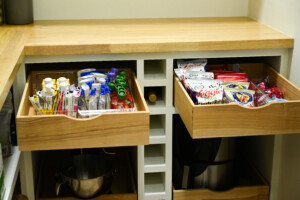
One of my favorite ways to reduce visual clutter in a pantry is to remove unnecessary boxes and packaging. Granola bars are a great example.
Instead of keeping several half-empty cardboard boxes on a shelf, we can remove the individual bars and place them together in a designated bin. We do the same thing with many individually packaged snacks.
This makes it easier to see what you have and how much is left. It also eliminates bulky packaging that can take up more space than the food inside. When you can see that there are three granola bars left, you know it’s time to add them to the grocery list. You don’t have to pick up a box, shake it, and wonder what’s inside!
Step 6: We Create an “Eat Now” Area
One pantry category I especially love is Eat Now. Maybe you have snacks approaching their best-by dates, an open package that needs to be finished, or food that keeps getting overlooked.
Instead of allowing those items to disappear into the pantry again, we put them together in an easy-to-see spot. It’s a simple way to remind everyone:
Eat these first!
For busy families, this can also make grabbing a snack or packing a lunch easier because those items are already front and center.
Step 7: We Use Containers to Create Boundaries
Containers aren’t just there to make a pantry look pretty. They’re one of the ways we help a pantry stay organized.
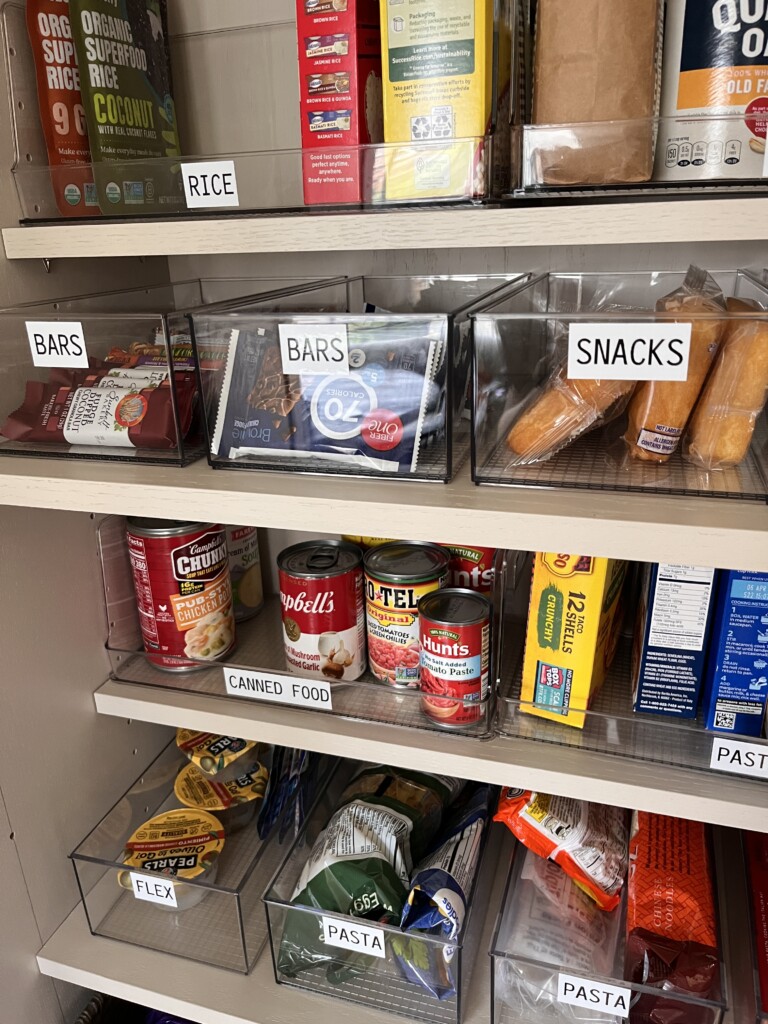
A bin creates a physical boundary for a category. Instead of snacks slowly spreading across three shelves, they have a designated home. When the snack bin is full, that’s useful information too. It tells you that you probably don’t need more snacks right now!
Depending on the pantry, I may use a combination of:
- Open bins
- Clear containers
- Baskets
- Turntables
- Can organizers
- Shelf risers
- Airtight food storage
- Stackable containers
I select products based on the pantry’s dimensions, what needs to be stored, the client’s preferences, and how easily the system will be maintained. I don’t believe in buying organizing products just for the sake of buying organizing products. Every product should have a purpose.
Step 8: Everything Goes Back in a Logical Location
Once we’ve edited, categorized, and selected the right products, we put everything back. This is when we think carefully about placement. Frequently used items need to be accessible. Kids’ snacks may need to be somewhere children can reach independently. Backstock can usually live in a less convenient location because you aren’t reaching for it every day.
The goal is to make the pantry intuitive. Ideally, you shouldn’t have to think very hard about where something belongs.
Step 9: We Add Labels That POP
Finally, we label! I love a good label, but labels aren’t just decorative. Labels help everyone in the family follow the system.
If a bin clearly says SNACKS, there’s no question about where the snacks go when you’re unloading groceries. If another says BACKSTOCK, everyone knows that’s where the extras belong.
I like labels that are easy to see—not tiny labels you have to squint to read. Clear, visible labels make it easier for the entire household to maintain the pantry instead of having one person responsible for knowing where everything belongs.
A Pantry Should Work for Your Real Life
Pinterest and Instagram can make it seem like there is one “right” way to organize a pantry.
There isn’t.
Some people need 20 cans of tomatoes organized and accessible. Other families rarely buy canned food. Some need an entire shelf for kids’ snacks. Others need a large section for baking. Some people shop at Costco and need significant backstock storage. Others buy groceries several times a week and need very little.
The best pantry organization system is the one designed around the way you live, shop, cook, and eat. That’s what I love about organizing pantries. We’re not just making the shelves look better—we’re creating a system that makes everyday tasks a little easier.
Looking for Pantry Organization in Omaha?
If your pantry is overflowing, you can’t find what you need, or you’ve bought organizing products but still can’t get the space to work, you don’t have to figure it all out yourself.
At Smart Move Organizing, we provide professional kitchen and pantry organization in Omaha, creating customized systems designed around your household and routines.
We can help with the entire process—from pulling everything out and sorting to selecting products, setting up categories, putting everything back, and adding labels so your new system is ready to use.
Because your pantry doesn’t need to look exactly like anyone else’s.
It needs to work for you.
My Favorite Pantry Organizing Products
Want to see some of the products I’ve actually used when organizing pantries for clients?
SHOP MY FAVORITE PANTRY ORGANIZING PRODUCTS
https://smartmoveorganizing.com/services